
Historical Sites and Ancient Cities
A journey through Yemen's World Heritage sites, historic cities, and civilizational centers that, over centuries, have formed part of Yemen's identity and its position within the cultural and commercial exchange network of the Indian Ocean.
This section presents a geographical and historical overview of Yemen's most important sites, including those inscribed on the UNESCO World Heritage List and civilizational centers with broad cultural influence.
Yemen's heritage reflects a unique geographical and historical diversity, extending from ancient fortified cities and established urban settlements to coastal ports and islands of unique environmental and historical character.
Geographical distribution of heritage
The interactive map allows exploration of historical sites by governorate, and displays the most prominent landmarks associated with each region.
Choose any governorate to explore its historical sites and learn about its civilizational footprint over time.

Old City of Sana'a
“A living architectural masterpiece through time.”
The Old City of Sana'a, the capital of the Republic of Yemen, is one of the oldest continuously inhabited cities in the world. It is distinguished by its decorated mudbrick tower houses adorned with white gypsum carvings and colored windows, giving it a unique identity as a city of mudbrick towers. It also houses prominent landmarks such as Bab al-Yemen and the Great Mosque, as well as traditional markets like Souq al-Milh.
A UNESCO World Heritage Site since 1986, it embodies architectural and cultural traditions that have endured for long centuries.
Yemeni architectural influences are reflected in some mosque patterns and decorative traditions in Indonesia through Hadrami communities.
City of Aden
“Gateway of the seas — where civilizations meet through trade.”
Aden is Yemen's maritime gateway to the world, a city that combines a rich commercial heritage with a unique strategic location inside a natural volcanic crater. Throughout history it served as a key stop on global maritime routes linking East and West, making it a vital center for trade, cultural exchange, and welcoming peoples from across the world.
Aden played a pivotal role as a commercial and strategic hub on international maritime routes, especially during the nineteenth century when it became one of the world's most prominent ports, benefiting from its vital proximity to the Bab al-Mandab Strait.
Aden is distinguished by historic landmarks such as Sira Fortress overlooking the harbor and the ancient Aden Cisterns, reflecting a cultural diversity resulting from its role as a global port through the ages.
Socotra Archipelago
“An island of wonders where nature is unlike anywhere else.”
Socotra features a unique ecosystem and is home to rare plants such as the Dragon's Blood tree, in addition to a high proportion of endemic species found nowhere else on Earth, making it one of the richest natural environments globally.
Designated a UNESCO World Heritage Site in 2008, it is considered one of the world's most important biodiversity hotspots.
Socotra historically served as an important stop on ancient maritime routes connecting Yemen with South and Southeast Asia, including Indonesia.
Old City of Shibam
“The Manhattan of the Desert — towers rising from the sands.”
The city of Shibam is distinguished by its towering mudbrick towers that rise dramatically above the desert, forming an integrated urban fabric dating back to the sixteenth century. It is considered one of the oldest and most remarkable examples of vertical urban planning in the world, reflecting the genius of Yemeni people in adapting to desert environments.
Inscribed on the UNESCO World Heritage List in 1982, it is considered a unique model of traditional architecture and early urban planning in challenging environments.
Hadramout was historically connected to trade and migration networks with Southeast Asia, including Indonesia, contributing to the exchange of architectural influences and ways of life.
City of Ibb
“The Green Heart of Yemen.”
Ibb is distinguished by its breathtaking natural landscape and is widely known as Yemen's "Green Province" due to its relatively high rainfall and fertile environment. The region is characterized by its agricultural terraces which reflect centuries of adaptation to mountainous terrain, supporting agricultural diversity and sustaining rural communities. Alongside its natural beauty, Ibb also holds a rich cultural heritage embodied in its traditional architecture and historic settlements.
Ibb represents one of Yemen's most important agricultural regions, showcasing traditional farming systems and harmony between people and the environment in the highlands.
The governorate includes prominent areas such as Jibla and Mount Ba'dan, known for their historical significance and panoramic views that combine heritage and nature.
Historic City of Zabid
“A city of knowledge and civilizational legacy.”
Zabid is one of Yemen's oldest historic cities and one of the most important centers of scholarship in the Islamic world, where the sciences of jurisprudence and Islamic knowledge flourished for long centuries, attracting scholars and students from across the Islamic world.
Inscribed on the UNESCO World Heritage List in 1993, in recognition of its historical, scholarly, and unique Islamic architectural value.
It houses prominent landmarks such as the Great Mosque, and its traditional Islamic architecture reflects the continuity of its civilizational prosperity through the ages.
City of Mukalla
“Where the sea tells the story of Hadramout across horizons.”
Mukalla is one of Yemen's most prominent coastal cities, distinguished by its deep maritime heritage and strategic location on the Arabian Sea coast. Throughout the ages it served as a key gateway for commercial and cultural communication between Yemen and the Indian Ocean region, and contributed to the flourishing of maritime activity and civilizational exchange. Its urban fabric and maritime heritage reflect an authentic Hadrami identity combining history and openness to the world.
Mukalla played a pivotal role in historic maritime trade networks connecting Yemen with East Africa and Southeast Asia, reinforcing its importance as a commercial and cultural hub.
The city houses prominent landmarks such as the Al-Qu'aiti Sultan's Palace, Al-Ghwayzi Fort, and the old harbor, alongside its traditional coastal neighborhoods, where sea views blend with Hadrami architecture in a scene that brings together heritage and nature.
Marib and the Ancient Temples
“The cradle of Sabaean civilization and a legacy of world heritage.”
Marib stands as one of the most significant centers of civilization in southern Arabia, housing a collection of ancient Sabaean temples of exceptional historical value, inscribed within the UNESCO World Heritage List. These monuments bear witness to the advanced religious, cultural, and architectural development of the Kingdom of Saba. The Marib Dam is also noted as one of the most remarkable engineering achievements in the ancient world, contributing to agricultural prosperity and urban stability in the region.
The temples of Marib are inscribed within the UNESCO World Heritage List for the prominent civilizational and human importance they represent in the history of the region.
Marib reflects Yemen's historic role in cultural and commercial exchange, where the influences of its civilization extended to wide regions through ancient trade routes.
City of Taiz
“A historic center of culture, knowledge, and resilience.”
Taiz is one of Yemen's most prominent historical and cultural centers, renowned for its long-standing contributions to education, literature, and intellectual life. The city flourished during various Islamic periods, particularly under the Rasulid state, leaving a rich legacy of architectural landmarks, schools, and mosques. Its urban fabric reflects a blend of historical depth and living cultural traditions, in the context of its strategic location in the highlands.
Taiz played a central role in shaping the cultural and intellectual scene in Yemen, where it was a center for scholarship, literature, and governance through the ages.
The city houses prominent landmarks such as Al-Qahira Castle and historic mosques, reflecting its architectural and cultural heritage within a distinctive mountainous landscape.
City of Tarim
The City of Mosques — where knowledge is passed across generations.
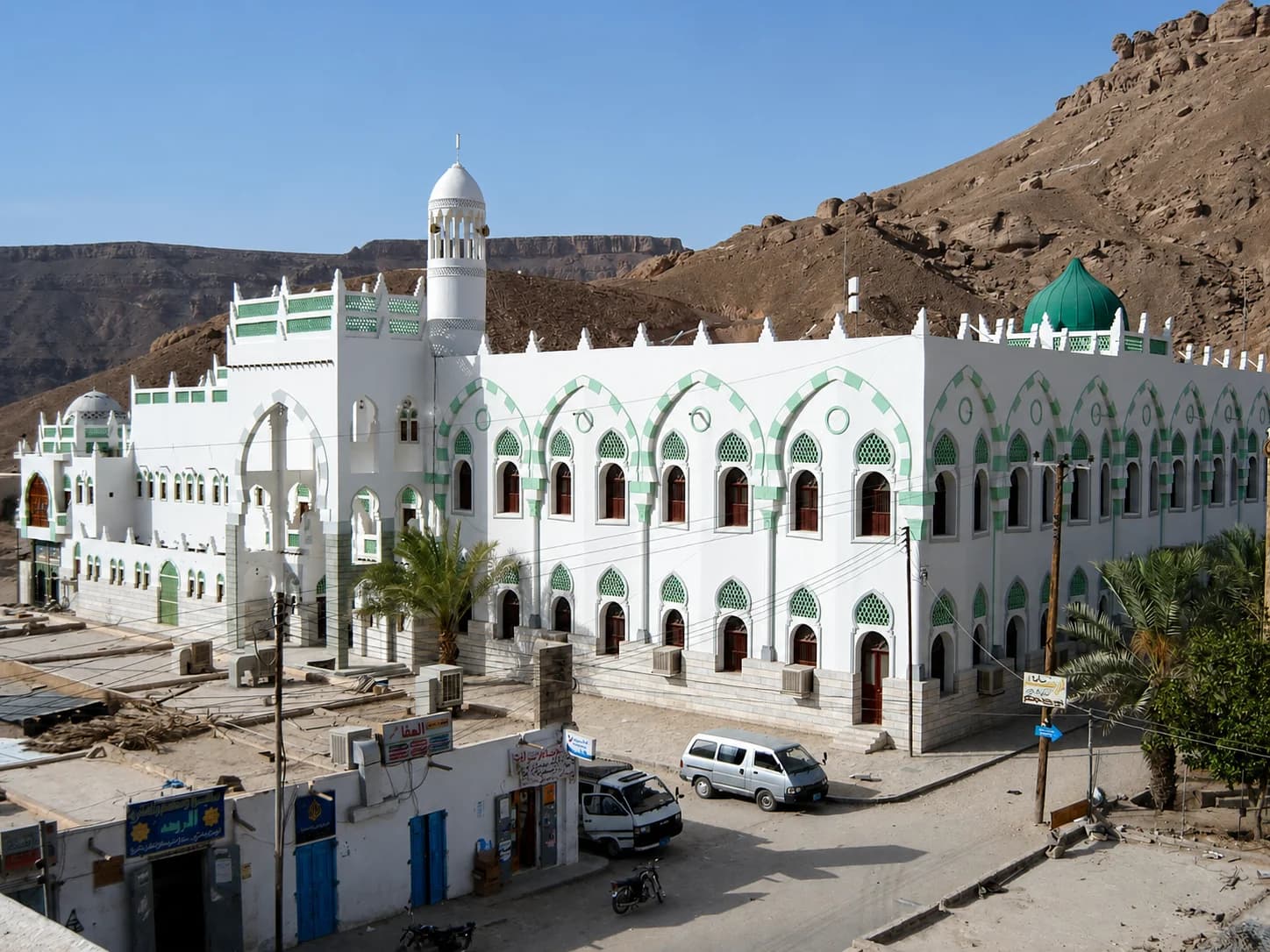
Tarim is one of the most important religious and cultural centers in Yemen and the Islamic world, where the Islamic sciences and knowledge flourished for long centuries, producing generations of scholars and missionaries who contributed to the spread of Islam in Indonesia, Malaysia, Singapore, India, and East Africa. It is also distinguished by its unique mudbrick architecture and historic palaces such as Rannat Palace, reflecting its civilizational and architectural richness.
Known as the City of Mosques, it houses hundreds of historic mosques and local tradition recalls their number once symbolically reaching 365, with the most iconic being Al-Mihdhar Mosque with its famous mudbrick minaret. It was also named the Capital of Islamic Culture in 2010 in recognition of its scholarly and civilizational role. Indonesian students form one of the largest international student groups.
Tarim is deeply connected to the Hadrami migration to Indonesia, where many families there trace their origins to Hadramout, making it one of the most influential cities in Yemeni-Indonesian cultural and religious relations.
From Hadramout to Java — a continuous legacy of knowledge exchange shaping Islamic learning across generations.
“Heritage is not what we inherit — it is what we choose to preserve.”